
Strengthening Monitoring and Evaluation systems in the Caribbean: key insights from the regional workshop hosted by CDB and CLEAR-LAC
On March 5th, more than 600 people joined the regional workshop “Tools for diagnosing and strengthening M&E systems in the Caribbean”, an event that brought together government representatives, international organizations, and evaluation specialists to reflect on how to strengthen national monitoring and evaluation (M&E) systems across the region. The workshop focused on the development of two tools: the MESA (Monitoring and Evaluation Systems Analysis) diagnosis, and the INCE (National Evaluation Capacity Index). Both tools are designed to assess the strength of national evaluation systems and support their development through participatory, evidence-based processes.
The event brought together to more than 600 M&E and evaluation specialists, government leaders, practitioners, and consultants from all continents, with a strong participation from Caribbean countries (70% of the participants joined from the Caribbean region, mainly from Trinidad & Tobago (119), Jamaica (32), Barbados (46), and Belize (17):
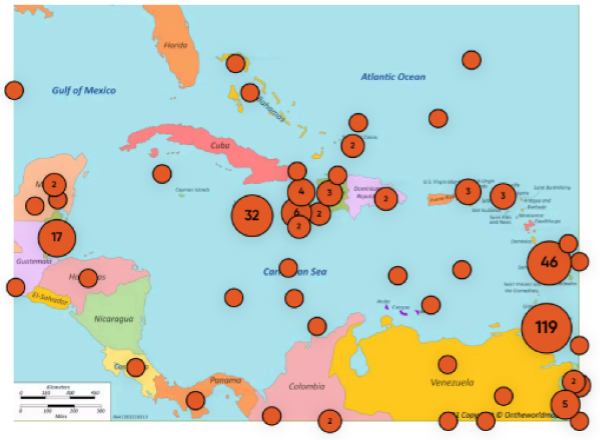
Held virtually, the event was organized by the Office of Independent Evaluation at the Caribbean Development Bank (CDB) and CLEAR-LAC and featured presentations from specialists involved in the development of these tools, as well as representatives from countries that have already applied them, including Jamaica, Trinidad and Tobago, Ghana, and Costa Rica. The audience was largely made up of Caribbean participants, especially young professionals and practitioners at early and mid-career stages in monitoring and evaluation.
Roberto La Rovere, Head of Evaluation, Office of Independent Evaluation (OIE), Caribbean Development Bank, underscored the importance of evaluation during the event:
“Evaluation helps us to understand whether we are doing the right things, and why things are working a certain way. It helps us to understand if we’re achieving meaningful change, if we are targeting the right issues in the right ways, and most importantly, what we must adjust”
Shantal Aragón, Director of Evidence Use at CLEAR-LAC, stressed that “evaluation systems are not built overnight, nor solely through tools; they are built through dialogue, trust, and institutional commitment.”
MESA: A systemic approach to monitoring and evaluation The first part of the workshop introduced MESA (Monitoring and Evaluation Systems Analysis), a tool designed to help governments analyze and strengthen their national M&E systems through a systemic lens. The approach takes into account not only technical processes, but also legal and regulatory frameworks, institutional capacities, available resources, and incentives for evidence use in decision-making. Ketevan Nozadze, Lead, Country Technical and Advisory Support at GEI, presented the tool and emphasized:
“MESA is not meant to impose a model; it is a flexible tool that can be adapted to the questions and priorities of each country.” (...) “Ultimately, the value of the exercise lies in the dialogue it generates among national stakeholders about how the system actually works.”
Jamaica’s experience implementing MESA, highlighted by Craig Barham, Chief Technical Director of the Performance M&E Branch, Office of the Cabinet, illustrated how this tool can help formalize diagnoses that previously existed only in an intuitive way. Craig Barham explained that the exercise made it possible to identify structural weaknesses in the system, including limited integration between monitoring, evaluation, knowledge management, planning, and budgeting, as well as a persistent reliance on unsystematic evidence in decision-making:
“We intuitively knew what was working well and what needed improvement, but we did not have the evidence to support those conclusions.”
Following the diagnosis, the country advanced reforms aimed at institutionalizing a results-based management approach, strengthening training, and fostering communities of practice.
In Trinidad and Tobago, the tool was adapted into an expanded approach called MESA+, which incorporated not only diagnosis, but also action planning and implementation support. Andrew Spencer, Programme Coordinator - Implementation, from the National Transformation Unit (NTU), highlighted that the process helped strengthen connections within the system and generate institutional learning through a network of M&E focal points and an internal support team. The diagnosis found that the country already has several M&E components in place, but that these still operate in a fragmented way. In his words, “the key finding is that the system exists and works, but it is not fully cohesive.”
INCE: measuring capacities and building learning networks
The second part of the workshop focused on the National Evaluation Capacity Index (INCE), presented as a tool for measuring and strengthening national evaluation systems through comparable indicators across countries.
The index examines dimensions such as institutional arrangements, evaluation policies, technical capacities, and the demand for and use of evaluative findings, and is applied through online surveys aimed at different actors within the evaluation ecosystem. Beyond measurement, it also seeks to create spaces for reflection, collaboration, and learning. As Juan Carlos Sanz, from DEval, explained, “INCE is not only a measurement tool; it is also a network that creates spaces for reflection, collaboration, and learning.”
Ghana's experience, highlighted by Sarah Adjei, showed that INCE helped make the capacities of the national evaluation system more visible, identify gaps, and support public policy discussions. Adjei emphasized that one of the process’s main contributions was to increase the visibility of the national system and help reactivate the review of an M&E policy that had been stalled for years. She also noted that the exercise made it possible, for the first time, to assess evaluation capacities at the subnational level. In her words, “one of the main benefits of INCE for us in Ghana is that it has given visibility to our national evaluation system.”
In Costa Rica, Carolina Zúñiga explained that INCE was directly integrated into the national evaluation policy and is used as an indicator to monitor progress in strengthening the system. At the same time, the results have pointed to persistent challenges, particularly around the effective use of evidence in decision-making across different sectors of the state and society.
Lessons learned and final reflections
The workshop also included a knowledge exchange, where some practical challenges were discussed regarding strengthening monitoring and evaluation systems.
One of the main issues discussed was how to encourage political leaders to recognize the value of these tools. Craig Barham argued that political support grows when M&E systems are linked to decision-makers’ priorities and help them demonstrate results and accountability.
Another key theme was the role of development partners and non-governmental actors. Andrew Spencer warned about the risk of parallel reporting structures emerging in response to external requirements and stressed the need to move toward more unified monitoring and reporting systems within government.
A central takeaway from the event was that strengthening national evaluation systems is a gradual, collaborative, and deeply institutional process—one that requires not only tools, but also leadership, coordination, and sustained commitment.