
The initiative brought together 31 professionals from 10 Caribbean countries and was delivered by CLEAR-LAC in collaboration with the Office of Independent Evaluation of the Caribbean Development Bank (OIE-CDB), with content tailored to the region’s specific contexts and challenges.
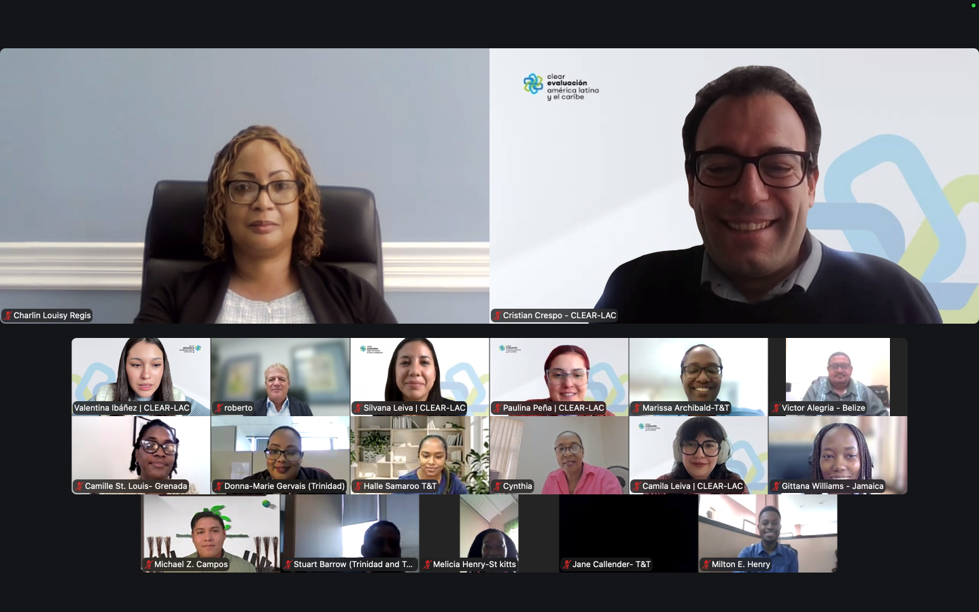
On July 22, the final session of the course Introduction to Monitoring and Evaluation (M&E) of Public Policies was held. The course was delivered by CLEAR-LAC in collaboration with the Office of Independent Evaluation of the Caribbean Development Bank (OIE-CDB). The initiative marks an important milestone for CLEAR-LAC, as its first course specifically designed for the Caribbean.
Over the course of 11 virtual sessions, 31 professionals from Antigua and Barbuda, Belize, the British Virgin Islands, Dominica, Grenada, Jamaica, Montserrat, Saint Lucia, Saint Kitts and Nevis, and Trinidad and Tobago strengthened their knowledge and skills in the design, monitoring, and evaluation of public policies.
The program covered topics such as problem diagnosis, theory of change, indicator development, implementation, outcome, and impact evaluation, as well as analytical methods, gender perspective, and monitoring and evaluation systems. Throughout the course, the content was adapted to the Caribbean context, and participants worked on exercises addressing real-world challenges faced by their countries and institutions.
A pivotal role was played by the Organisation of Eastern Caribbean States (OECS), which facilitated the participation of representatives from several Eastern Caribbean countries and territories. Kervyn Tobias, Monitoring and Evaluation Manager at the OECS Commission, highlighted, in the first session of the course, the importance of ensuring that regional learning initiatives take into account the specific realities of Small Island Developing States:
“Participation in regional learning spaces allows the tools, approaches, and lessons shared to be grounded in the realities of Small Island Developing States. Our experiences enrich the regional dialogue and contribute to developing more relevant and practical solutions,” Tobias said.
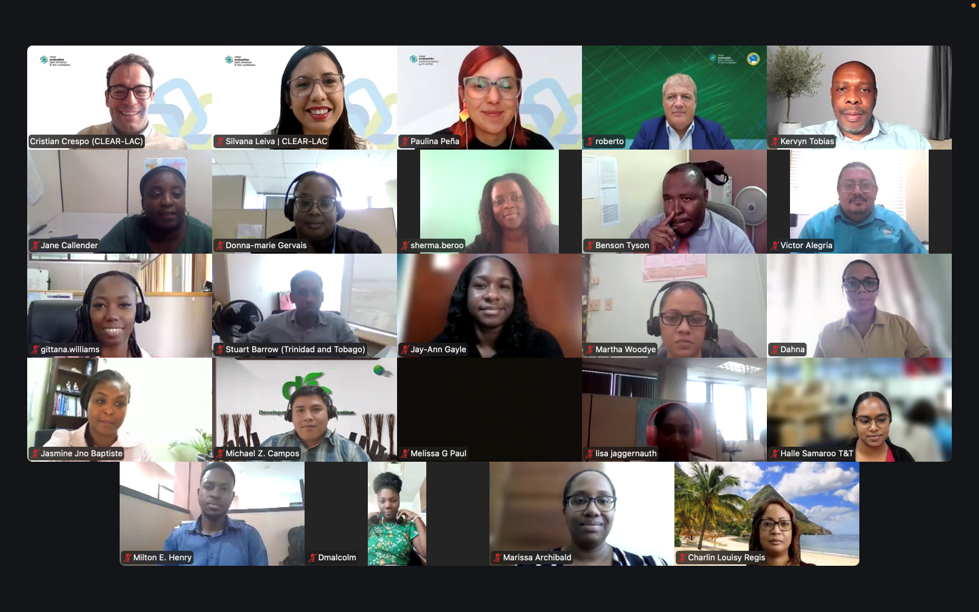
Roberto La Rovere, Head of the Office of Independent Evaluation at the Caribbean Development Bank, also emphasized the value of creating opportunities for learning and collaboration in a region where countries face complex and often shared development challenges.
“Although the Caribbean countries have very different contexts, many development challenges are shared. Regional cooperation and peer learning are therefore essential to identifying practical and evidence-based solutions that can help move the Caribbean further forward,” La Rovere said.
The final session also provided an opportunity to showcase some of the work developed by participants throughout the program. Through three integrated assignments, they progressively applied the course content to their own contexts. The cases presented addressed challenges such as road safety in Belize and the implementation of a food support program in Trinidad and Tobago.
Reflecting on her experience in the course, Charlin Louisy Regis, Chief Economist at the Ministry of Economic Development and Youth Economy of Saint Lucia, highlighted both the knowledge gained over the ten-week program and the connections built among professionals from across the region.
“Perhaps one of the most valuable lessons from this experience is that none of us has to address the challenges that we face alone. Our peer learning, our knowledge sharing, our regional collaboration are very powerful resources that we can tap into. The professional connections that we have built throughout this course across the Caribbean are just as valuable as the technical knowledge we've gained.”
For Cristian Crespo, Executive Director of CLEAR-LAC, the experience was also a learning process for the Center and another step forward in the work being carried out with the CDB to strengthen evaluation capacities in the Caribbean. During the closing session, Crespo noted that the course had also been a learning experience for CLEAR-LAC. He emphasized that the center is working closely with the CDB to strengthen evaluation capacities across the region and described the initiative as only the beginning of this collaboration.
The conclusion of the course also reinforced the importance of sustaining the connections built among participants. Both CLEAR-LAC and OIE-CDB emphasized the opportunity to continue fostering the exchange of experiences, peer learning, and the development of a regional community of professionals committed to strengthening the use of evidence in public policy across the Caribbean.
The initiative is part of the ongoing collaboration between CLEAR-LAC and the Office of Independent Evaluation of the Caribbean Development Bank to strengthen evaluation capacities and national M&E systems across the region and contribute to stronger institutions and better public policies.
